

In the world of consumer goods, agility has become the ultimate competitive edge. A viral social trend, a sudden weather shift, or a global supply disruption can alter demand patterns overnight. Yet, many organizations still rely on traditional forecasting methods that were built for a more predictable era.
It’s time to evolve. Machine Learning (ML) is no longer a futuristic concept, it’s a business-critical capability that can transform how companies anticipate demand, plan production, and manage inventory.
At SmartCons, we believe the companies that harness ML driven forecasting today will define the winners of tomorrow’s marketplace.
1. From Reactive Forecasting to Predictive Intelligence
Conventional forecasting relies heavily on historical data and linear relationships. But consumer behavior today is anything but linear.
Machine Learning models can process vast, diverse data sources point-of-sale trends, promotional calendars, online reviews, weather data, macroeconomic indicators, even social sentiment to uncover hidden demand drivers.
For instance:
- ML can detect a surge in beverage demand linked to upcoming heatwaves weeks in advance.
- It can learn from years of promotional data to accurately quantify the true uplift of a discount or campaign.
The result is more accurate, earlier, and context-aware forecasts, empowering planners to act before demand swings happen, not after.
2. Turning Volatility Into a Strategic Advantage
In recent years, volatility has become the new normal. From raw material shortages to sudden shifts in consumer priorities, disruptions are now constant.
Machine Learning thrives in this environment. Unlike static statistical models, ML algorithms continuously learn and adapt as new data arrives. They identify emerging trends,such as the rise of private labels or the shift toward smaller pack sizes, before they become visible in lagging indicators.
Every forecast error becomes an input for learning. Over time, your forecasting system doesn’t just react to change it gets smarter with it.
3. From Forecast Accuracy to Business Impact
Improving forecast accuracy isn’t an end in itself, it’s a lever for broader business performance.
Machine Learning brings tangible results across the value chain:
- Reduced inventory costs through optimized safety stock and replenishment levels.
- Higher service levels from better demand sensing and reduced stockouts.
- Stronger financial alignment, as Sales, Marketing, Finance, and Supply Chain work off one unified forecast baseline.
- Smarter production planning, enabling efficient use of capacity and materials.
Industry leaders adopting ML forecasting report 10–30% improvements in forecast accuracy, translating directly into higher margins and better customer satisfaction.
4. Empowering Planners, Not Replacing Them
A common misconception is that ML will replace planners. In reality, it augments human intelligence.
By automating data analysis and pattern detection, ML frees planners to focus on high-value tasks, such as scenario planning, demand shaping, and strategic collaboration with Sales and Marketing.
Modern planning systems like SAP Integrated Business Planning (IBP), when enhanced with embedded ML capabilities, seamlessly blend machine intelligence with human judgment. The result is faster, smarter, and more confident decision-making across the organization.
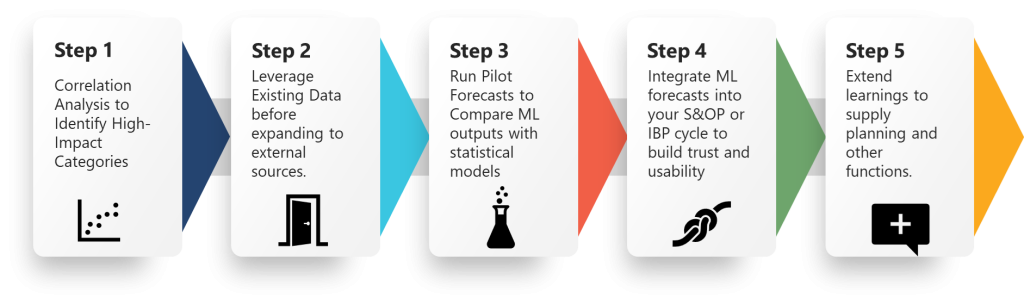
5. A Practical Roadmap to ML Forecasting Success
Adopting ML for forecasting doesn’t require a massive transformation on day one. The most successful journeys start small, deliver measurable impact, and then scale.
At SmartCons, we recommend a structured, business-first approach:
At SmartCons, we help consumer goods companies turn forecasting into a growth engine by combining deep supply chain expertise with cutting-edge analytics and ML-driven insight.
Write to info@smartcons.nl to get started with your Machine Learning Journey.