

How Machine Learning is transforming forecasting in consumer goods.
A viral trend, a heatwave, or a single supply disruption can rewrite demand overnight. At SmartCons, we believe the companies that harness ML driven forecasting today will define the winners of tomorrow’s marketplace.
In the world of consumer goods, agility has become the ultimate competitive edge. Yet many organizations still rely on forecasting methods built for a far more predictable era – and the cost of that gap is widening every quarter.
Machine Learning is no longer a futuristic concept. It is a business-critical capability that is reshaping how companies anticipate demand, plan production, and manage inventory. The question for most leadership teams is no longer whether to adopt it, but how to adopt it without stalling on a multi-year program.
A practical roadmap to ML forecasting success
The most successful ML forecasting journeys do not begin with a transformation. They begin with a focused pilot, deliver measurable value, and then scale. Below is the structured, business-first approach we recommend.
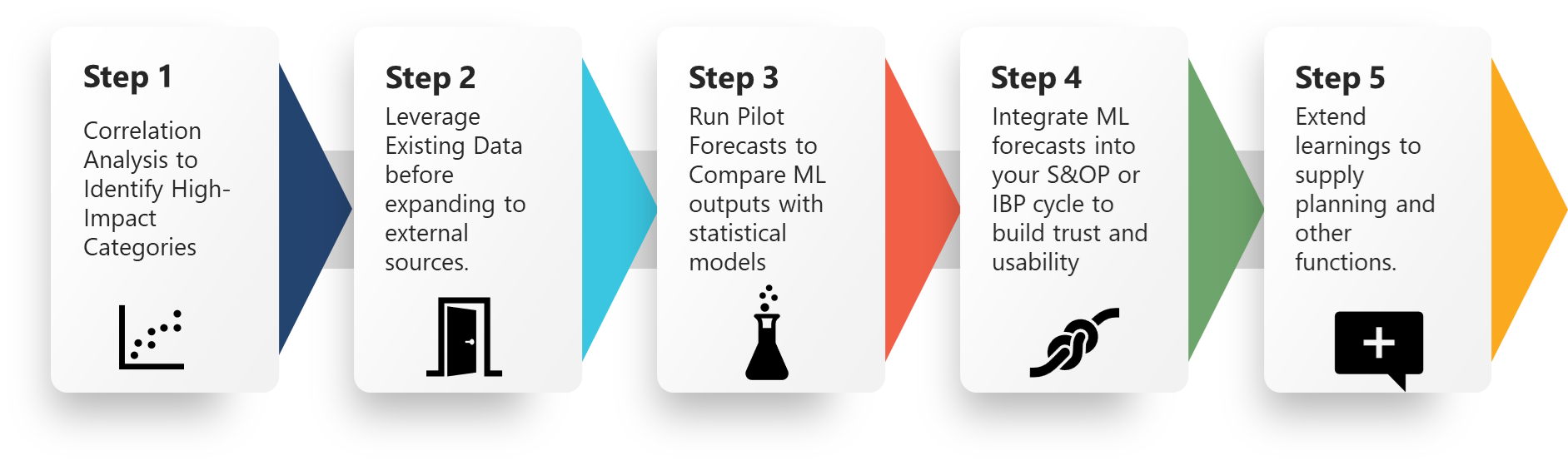
→ Explore each step in detail below
Begin by surfacing the categories, customers, and channels where ML will move the needle most. A short correlation analysis between historical demand and known drivers – promotions, weather, pricing, macro signals – reveals where the upside lives, before any model is built.
Step 01 – Correlate – is where ML earns its keep before a single forecast is generated. Variable impact analysis ranks the demand drivers the model is leaning on, exposing whether the signal is coming from baseline trend, promotional activity, pricing, weather, or something else entirely. Below is a real example from a SmartCons engagement.
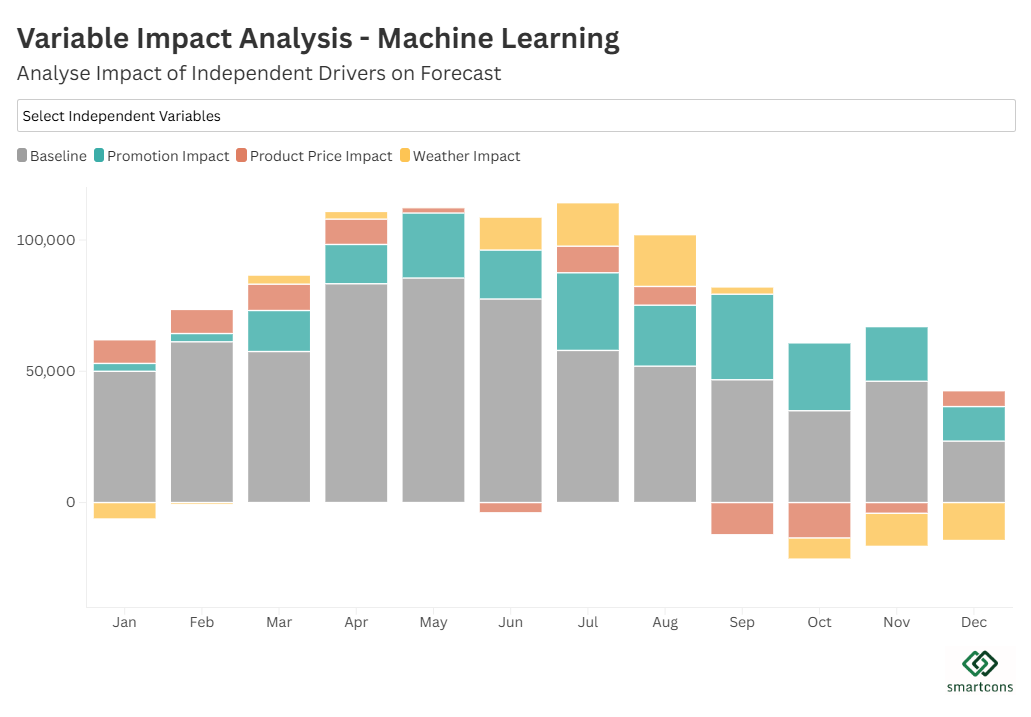
Each bar represents the contribution of a given driver – promotional events, weather, pricing, base trend, seasonality – to the final forecasted volume. For a planning team, that ranking is gold. It tells you where the demand is really coming from, lets you challenge or override individual signals with confidence, and turns ML from “the model said so” into a structured negotiation between data and judgement.
The old question was ‘what will demand be?’ The new one is ‘which signals are driving it — and which ones are we still ignoring?
From reactive forecasting to predictive intelligence
Conventional forecasting leans heavily on historical data and linear relationships. But consumer behaviour today is anything but linear. Machine Learning models can ingest vast and diverse data sources – point-of-sale trends, promotional calendars, online reviews, weather data, macroeconomic indicators, even social sentiment – to surface hidden demand drivers.
- ML can detect a surge in beverage demand linked to upcoming heatwaves weeks in advance.
- It can learn from years of promotional history to accurately quantify the true uplift of a discount or campaign.
- It can separate true demand from sells-in noise driven by trade-loading or one-off allocations.
The result: more accurate, earlier, and context-aware forecasts that empower planners to act before demand swings happen, rather than after.
Sells-In and Sells-Out – two forecasts, one truth
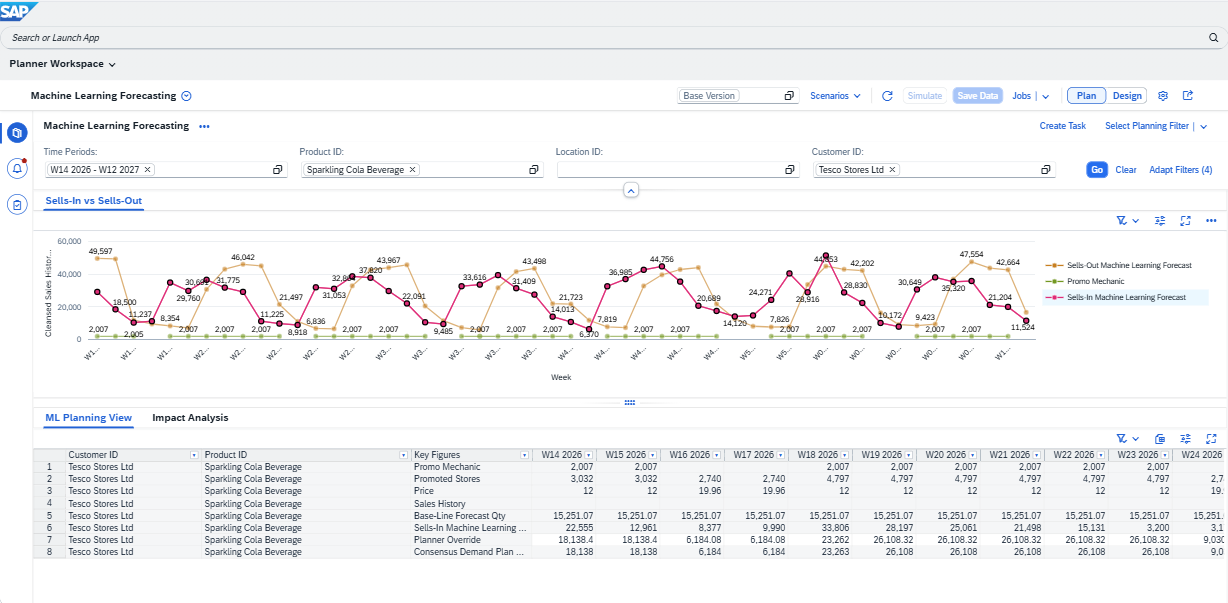
Running an ML forecast on Sells-In and Sells-Out side by side – as shown above – is something most consumer goods organisations stop short of doing. The distinction matters more than it sounds.
Driven by trade terms, listing fees, promotional buy-ins, retailer inventory policy, and end-of-quarter pressure. Sells-in is what your finance team books as revenue – and it’s noisy, lumpy, and easy to manipulate.
The cleaner, leading-indicator signal – pulled from POS data, retailer scan data, and loyalty programs. Sells-out reflects real consumer demand, smoothed of trade distortion, and sits closer to the moment of decision at the shelf.
Most consumer goods companies already have the data to forecast both. POS feeds from major retailers, GS1-standardised scan data, and direct e-commerce sales sit in spreadsheets and data lakes that the planning team rarely touches. ML changes that calculation: with the right pipeline, a sells-out forecast becomes a real-time read on consumer demand, and the gap between sells-in and sells-out becomes your early-warning system for over-shipment, channel inventory build-up, and promotional cannibalisation.
Turning volatility into a strategic advantage
Volatility has become the new normal. From raw material shortages to sudden shifts in consumer priorities, disruption is now constant rather than exceptional.
Machine Learning thrives in this environment. Unlike static statistical models, ML algorithms continuously learn and adapt as new data arrives. They identify emerging trends – the rise of private labels, the shift toward smaller pack sizes – before they show up in lagging indicators. Every forecast error becomes an input for learning. Over time, the system doesn’t just react to change; it gets smarter with it.
From forecast accuracy to business impact
Improving forecast accuracy is not an end in itself. It is a lever for broader business performance, with tangible results across the value chain:
- Reduced inventory costs through optimised safety stock and replenishment levels.
- Higher service levels from better demand sensing and fewer stockouts.
- Stronger financial alignment, as Sales, Marketing, Finance, and Supply Chain work off one unified forecast baseline.
- Smarter production planning, enabling efficient use of capacity and materials.
Empowering planners, not replacing them
A common misconception is that ML will replace planners. In reality, it augments human intelligence.
By automating data analysis and pattern detection, ML frees planners to focus on the work where judgment matters most: scenario planning, demand shaping, and strategic collaboration with Sales and Marketing. Modern planning systems such as SAP Integrated Business Planning (IBP), when enhanced with embedded ML capabilities, blend machine intelligence with human judgment seamlessly. The result is faster, smarter, and more confident decision-making across the organisation – with planners firmly in the driver’s seat.
Turn forecasting into a growth engine.
We help consumer goods companies translate ML-driven insight into measurable supply chain performance – anchored in the practical, step-by-step roadmap above.
Begin your ML journey →